
Ancient Wisdom, Modern Science: What is the Best Healing Clay?
People have been using healing clay since ancient Egypt. Think about that for a second: thousands of years of humans reaching for mud when they needed to heal. But here's the thing: just because something is ancient doesn't automatically make it safe or effective by today's standards.
So when you're asking "what is the best healing clay?": you're actually asking two questions. What worked historically, and what stands up to modern scientific scrutiny?
Let's dig in.
The Ancient Wisdom Part
Healing clays weren't some fringe practice. They were mainstream medicine for millennia.
Cleopatra used clay face masks. Roman gladiators packed their wounds with it. Indigenous cultures across every continent developed their own clay healing traditions. French villagers discovered volcanic clay deposits and built entire healing practices around them.
Why? Because it worked.
Clay naturally pulls toxins from the skin, reduces inflammation, and creates an environment where bacteria struggle to survive. Our ancestors didn't understand the science behind cation exchange capacity or mineral composition: they just knew that when you applied clay to an injury or skin condition, healing happened faster.

But here's where ancient wisdom needs modern science: not all clay is created equal.
What Actually Makes Healing Clay "Best"
The "best" healing clay isn't about color or exotic origin stories. It comes down to three things:
1. Mineral Composition
The right blend of minerals: silica, magnesium, calcium, potassium, iron: determines how effectively clay can draw out impurities and support skin repair. Different clay types offer different mineral profiles.
2. Purity and Safety
This is where most "ancient" clays fail modern standards. Natural doesn't mean safe. Clay deposits can contain heavy metals like lead, arsenic, and mercury. A recent study found that many commercial healing clays contain concerning levels of toxic metals that can absorb into your skin.
3. Scientific Validation
Real clinical studies. Not just testimonials or traditional use. Actual peer-reviewed research showing measurable healing outcomes.
Most clay brands only check one or two of these boxes. Very few check all three.
The Different Types of Healing Clay
Let's break down what you'll actually find on the market:
Bentonite Clay
The most absorbent option: can absorb up to 700% of its mass in water. It's got a strong negative charge that pulls positively charged toxins and bacteria from your skin. Great for oily or acne-prone skin, but it can be too harsh for sensitive types.
The problem? Most bentonite clays sold today haven't been tested for heavy metal content.
Kaolin Clay
Gentler and milder. Only absorbs about 60% of its mass in water, making it suitable for dry or sensitive skin. White kaolin is the softest, yellow is slightly more exfoliating, and red kaolin is more absorbent.
The catch? It lacks the mineral diversity needed for serious injury recovery or inflammation reduction.
Rhassoul Clay
From Morocco's Atlas Mountains. Rich in magnesium, calcium, potassium, and silica. It's hydrating and works well for inflammation, eczema, or psoriasis.
The reality? Limited scientific research and inconsistent sourcing mean quality varies wildly between brands.
Fuller's Earth
Highly absorbent, used traditionally for hyperpigmentation and oil control.
The issue? Like most clays, it's rarely tested for contaminants.
The Modern Problem: Heavy Metals
Here's what nobody talks about: natural clay deposits are contaminated.
A 2020 study published in the National Institutes of Health examined commercial healing clays and found elevated levels of lead in multiple products. Lead. The same toxic metal we've spent decades removing from paint, gasoline, and children's toys.
Another study on medicinal clays confirmed that natural geological deposits: especially those near industrial areas or used in traditional medicine: often contain arsenic, mercury, and other heavy metals at levels that can pose health risks with repeated skin exposure.
This isn't some rare occurrence. It's a widespread industry problem that most clay brands conveniently ignore because testing is expensive and the results aren't pretty.
You're trying to heal your body, not poison it.
Why Scientific Standards Matter
Ancient wisdom told us clay works. Modern science tells us why: and more importantly, tells us which clays are safe to actually use.
Research from Cambridge University analyzed French green clays used for healing and identified the specific mineral and chemical characteristics that make them effective. The study confirmed what doctors and researchers have proven: the right clay composition can reduce inflammation, support tissue repair, and accelerate recovery.
But here's the kicker: the study also emphasized the importance of sourcing location and contamination testing. The healing properties only matter if the clay is pure.
What is the Best Healing Clay? The One That's Actually Safe
So here's your answer: the best healing clay is one that combines traditional effectiveness with modern safety standards.
That means:
- ✓ Tested and certified heavy metals free
- ✓ Sourced from clean, volcanic regions
- ✓ Backed by clinical research showing measurable healing outcomes
- ✓ Contains a proven blend of therapeutic minerals
- ✓ Trusted by medical professionals and elite athletes
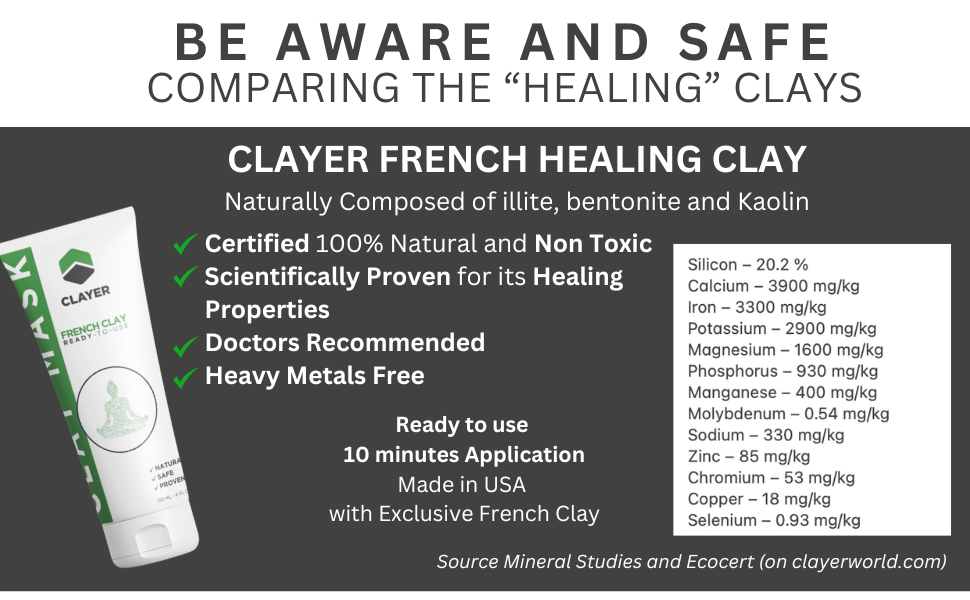
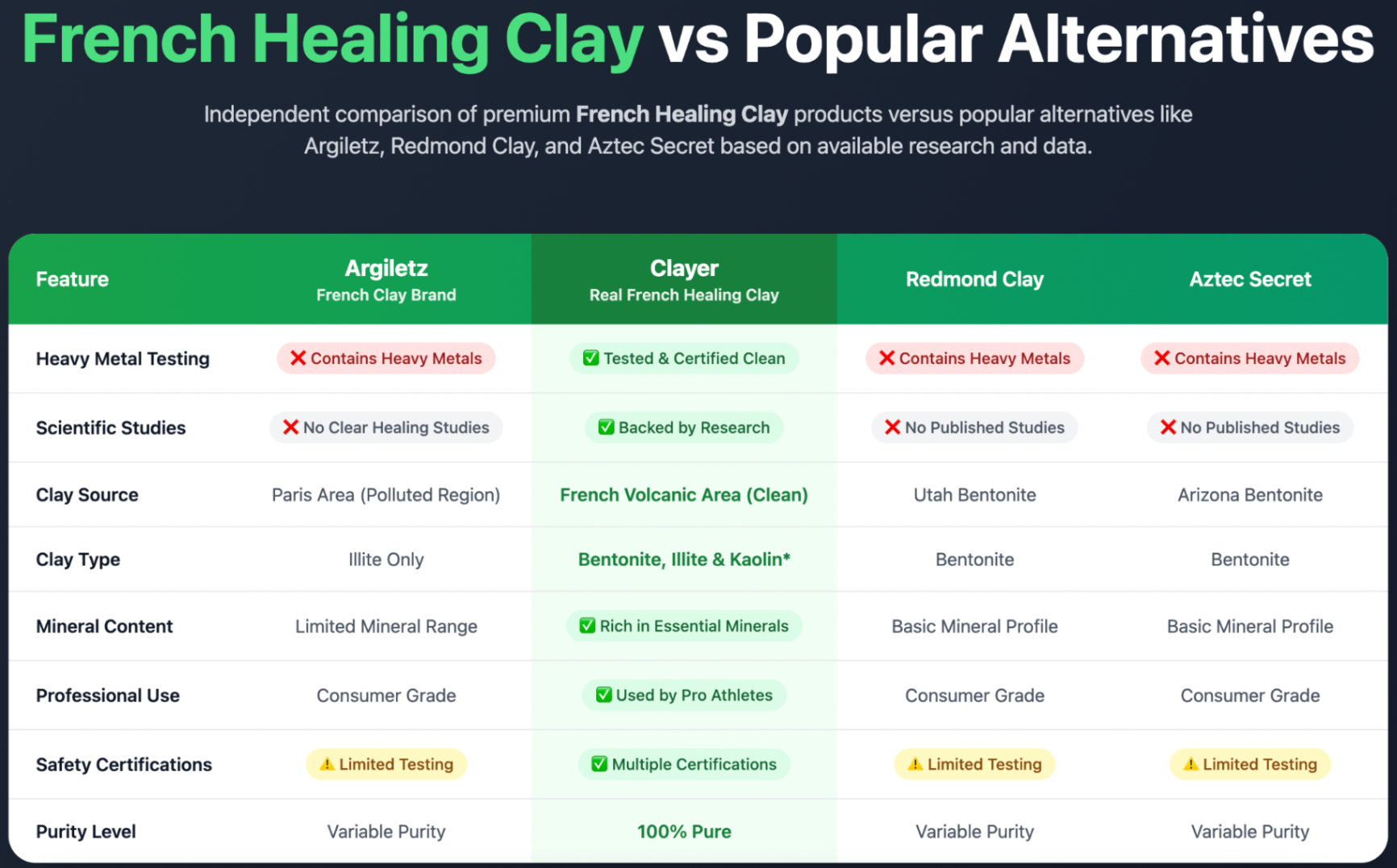
CLAYER's French healing clay checks every single box.
It's the only clay on the market that's been rigorously tested for heavy metals and certified 100% pure. The clay comes from a pristine volcanic region in France: the same deposits that have been used for therapeutic purposes for centuries, but with modern extraction and testing protocols.
The mineral blend: bentonite, illite, and kaolin: provides maximum therapeutic benefit. Clinical studies show it reduces inflammation, supports tissue healing, and accelerates recovery from injuries and skin conditions.
And unlike other brands that rely on marketing hype, CLAYER is recommended by sports doctors and used by professional athletes who demand results.
Ancient Wisdom Meets Modern Standards
Your ancestors were right about healing clay. But they didn't have access to spectrometers, heavy metal testing, or peer-reviewed clinical trials.
You do.
The best healing clay isn't about choosing between ancient wisdom and modern science: it's about demanding both. It's about respecting traditional knowledge while insisting on contemporary safety standards.
Because healing shouldn't come with a side of lead poisoning.
When you're ready to experience what real, pure, scientifically-validated healing clay can do, check out CLAYER. Whether you're dealing with sports injuries, skin conditions, or just want the safest, most effective natural healing solution available: this is what you've been looking for.
100% natural. 100% pure. 100% proven.
No heavy metals. No synthetic additives. No compromises.
Just clay that actually works the way nature and science intended.


