The Best Exercises for Knee Pain (and When to Rest)
The best exercises for knee pain are low-impact movements that strengthen the muscles around your knee: particularly your quadriceps, hamstrings, and glutes. Think calf raises, glute bridges, half squats, clamshells, and straight-leg lifts. These gentle strengthening exercises paired with smart recovery strategies (hello, natural healing clay) can help you move pain-free again.
Let's break down exactly what works, when to push through, and when your body's telling you it needs a break.
Why The Best Exercises Focus on Support Muscles
Your knee doesn't work alone. It's supported by a network of muscles that stabilize the joint and absorb shock with every step. When these muscles are weak or imbalanced, your knee takes the brunt of the force: leading to pain, inflammation, and that nagging discomfort that won't quit.
The good news? Strengthening these support muscles can reduce knee pain significantly without aggressive treatments or medications. You're basically building a natural support system around your knee.

The Best Exercises for Knee Pain Relief
Calf Raises: Simple but Mighty
Stand with your feet shoulder-width apart and slowly rise onto your toes, then lower back down with control. Hold onto a chair or wall if you need balance support.
How to do it right:
- Keep your movements slow and controlled
- Focus on the muscles working, not speed
- Perform 2-3 sets of 10 repetitions
- If it hurts, reduce your range of motion
This exercise strengthens your calves, which play a crucial role in knee stability during walking and running.
Glute Bridges: Your Knee's Best Friend
Lie on your back with knees bent and feet shoulder-width apart. Lift your hips toward the ceiling until your body forms a straight line from shoulders to knees. Hold for a few seconds, then lower with control.
Why this works:
Glute bridges relieve excess pressure from your knees by improving hip stability. When your hips are strong and stable, your knees don't have to overcompensate. It's like giving your knee a supportive teammate.
Do 2-3 sets of 12 repetitions, focusing on squeezing your glutes at the top of the movement.
Half Squats: Power Without the Pain
Full squats might be too much when your knee is angry, but half squats are perfect. Stand with feet shoulder-width apart and squat down about 10 inches, basically the halfway point. Then push through your heels to stand back up.
Pro tip: Keep your weight in your heels, not your toes. This simple adjustment takes pressure off your knees and puts it where it belongs: in your glutes and hamstrings.
Complete 2-3 sets of 10 repetitions. If you feel sharp pain, reduce your depth even more.

Clamshells: The Hip Stabilizer
Lie on your side with your hips stacked and knees bent. Keep your feet together and lift the top knee up like a clamshell opening. This targets your hip abductors, which directly influence knee alignment.
The connection: Weak hip muscles allow your knee to collapse inward during movement, creating stress on the joint. Clamshells fix this misalignment at the source.
Repeat 15-20 times on each side, keeping the movement controlled and deliberate.
Straight-Leg Lifts: Quad Strength Without Bending
Lie on your back with one leg bent and the other straight. Contract the quadricep of your straight leg and raise it off the floor until it matches the height of your bent knee. Hold for 5 seconds, then lower slowly.
This exercise builds quadricep strength without putting stress on the knee joint itself. Your quads are the primary stabilizers of your knee, so this is non-negotiable for long-term knee health.
Do 2-3 sets of 10 repetitions per leg.
Low-Impact Cardio That Actually Helps
Strengthening exercises are only half the equation. Low-impact aerobic activities keep your knee joint mobile while building endurance in those support muscles.
Water aerobics is considered the gold standard for knee pain. The water reduces weight on your joints while allowing you to perform exercises like squats and lunges that build strength around the knee. It's like strength training with a built-in safety net.
Biking (stationary or outdoor) helps improve range of motion, flexibility, and strength while being significantly easier on your knees than running. Start with low resistance and gradually increase as your strength builds.
Swimming provides full-body conditioning without any joint impact. It's perfect for maintaining fitness while your knee heals.
Walking might seem too simple, but it's incredibly effective for maintaining knee mobility and building endurance. Start with short distances on flat surfaces and gradually increase as tolerated.
When to Rest (and When to Push)
Here's where it gets tricky. Rest is important, but too much rest can actually make knee pain worse by allowing muscles to weaken and joints to stiffen.
Rest when you experience:
- Sharp, stabbing pain during or after exercise
- Swelling that increases after activity
- Pain that disrupts your sleep
- Instability or feeling like your knee might give out
- Pain that lasts more than 2-3 days after a specific activity
Keep moving (gently) when you have:
- General soreness or stiffness that improves with movement
- Dull, achy pain that doesn't worsen during exercise
- Morning stiffness that loosens up throughout the day
- Discomfort that stays at the same level or improves during activity
The key is listening to your body. Pain is information, not necessarily a stop sign. Soreness and discomfort during rehabilitation are normal. Sharp pain and swelling are not.
The Recovery Secret: Natural Healing Clay
Here's what most knee pain advice misses: recovery is just as important as the exercises themselves. You can do all the right movements, but if you're not actively reducing inflammation and promoting healing between workouts, you're only doing half the work.
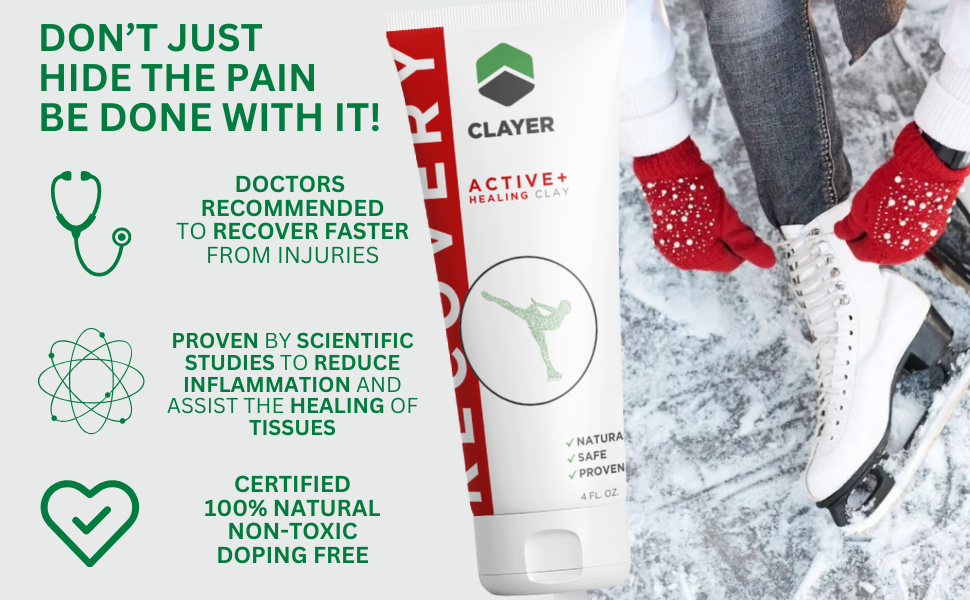
French green healing clay has been used for centuries to reduce inflammation and accelerate recovery. CLAYER's Active+ Healing Clay is scientifically proven to reduce inflammation, is 100% natural and non-toxic, and is trusted by professional athletes and recommended by sports doctors.
How to use it:
Apply the clay directly to your knee after exercise. Cover the area completely and let it sit for 15 minutes. The clay draws out inflammation and promotes tissue healing at the cellular level. Then rinse off with water or in the shower.
It's that simple. No pills, no chemicals, just proven natural healing that works with your body's recovery process.
Learn more about how top athletes use CLAYER for recovery and why sports doctors recommend it.
Building Your Knee Recovery Routine
Here's a practical weekly schedule to get you started:
Monday, Wednesday, Friday:
- Warm up with 5 minutes of gentle walking
- Complete 2 sets of each strengthening exercise
- Cool down with light stretching
- Apply CLAYER healing clay to your knee for 15 minutes
Tuesday, Thursday:
- 20-30 minutes of low-impact cardio (biking, swimming, or water aerobics)
- Apply CLAYER for recovery
Saturday:
- Gentle yoga or tai chi for mobility
- Focus on hip and ankle flexibility
Sunday:
- Active rest (light walking or stretching)
Consistency beats intensity every single time. It's better to do these exercises regularly at a moderate level than to go hard once and then skip a week because you're too sore.
Your Next Step
Knee pain doesn't have to sideline you. With the right exercises, smart rest periods, and natural recovery support, you can build stronger, more resilient knees that support everything you want to do.
Start with just one or two exercises today. Add in low-impact cardio when you're ready. And give your body the recovery support it deserves with CLAYER's proven healing clay.
Your knees have carried you this far. Now it's time to strengthen them for everything that's ahead. You've got this.