
Natural Baby Powder: What “Natural” Should Really Mean for Your Baby’s Skin
How would you feel if you could choose a baby powder with a short, transparent ingredient list instead of trying to decode a long label?
For many parents, “natural” sounds reassuring. But natural does not automatically mean talc-free, fragrance-free, heavy-metal-free, or suitable for delicate baby skin. The label needs to tell you more.
A truly thoughtful natural baby powder should be:
- Talc-free
- Certified 100% natural
- Non-toxic
- Free from synthetic fragrance
- Free from unnecessary additives
- Tested for heavy metals
- Designed for sensitive skin
- Clear about every ingredient
That is the standard CLAYER was created to meet.
What Should Natural Baby Powder Really Mean?
The word “natural” is not enough by itself. A powder can contain naturally derived ingredients and still include fragrance components, essential oils, multiple botanical allergens, or ingredients that do not match your family’s needs.
When choosing a natural baby powder, read beyond the front label. Look for evidence of:
1. A short and recognizable ingredient list
The fewer unnecessary ingredients, the easier it is to understand what is touching your baby’s skin.
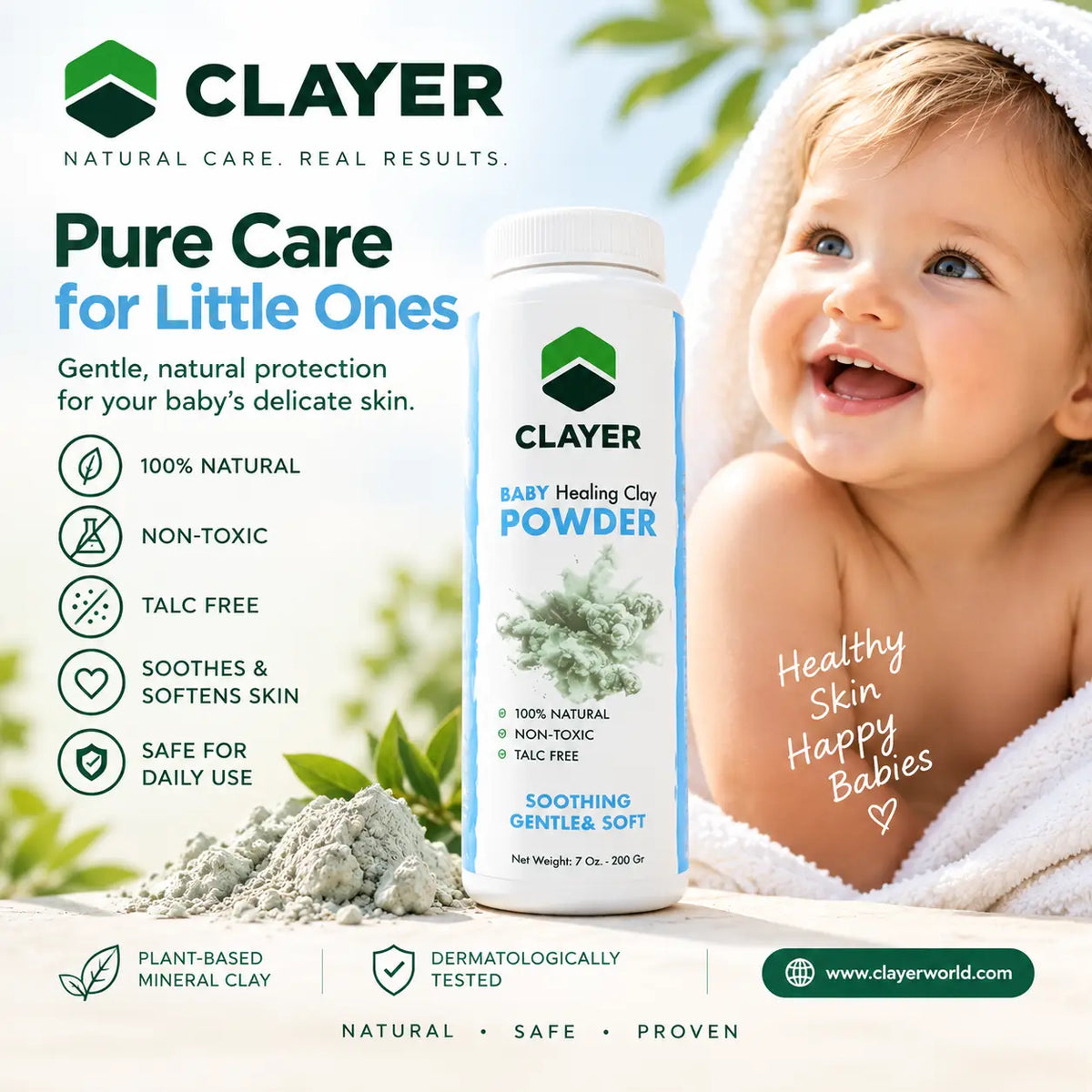
CLAYER Baby Healing Clay Powder is made with pure French green clay. The product page describes it as:
- Talc-free
- Cornstarch-free
- Synthetic-fragrance-free
- Paraben-free
- Dye-free
- Heavy-metal-free
- Food-grade
- Certified non-toxic
CLAYER also positions the formula as 100% natural, plant-based mineral clay, dermatologically tested, and suitable for daily use when applied correctly.
2. No synthetic fragrance
A powder can smell pleasant and still be a poor fit for fragrance-sensitive skin. “Fragrance” may refer to a blend of ingredients that are not individually disclosed.
Some natural products use essential oils instead. These may be naturally derived, but they are still scented ingredients and can irritate some sensitive skin.
If your goal is the simplest possible routine, choose a product that clearly states it is fragrance-free and check the complete ingredient list.
3. Heavy-metal testing
Clay is a natural mineral, but natural does not mean automatically pure. Mineral ingredients should be tested for unwanted contaminants, including heavy metals.
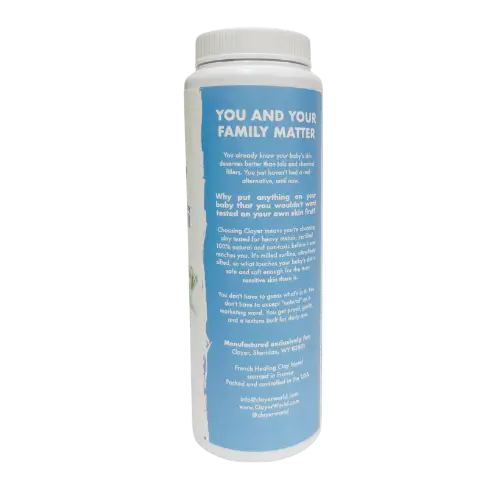
Look for a brand that can clearly explain its testing standards. CLAYER Baby Healing Clay Powder is marketed as heavy-metal-free, with a certificate of analysis available on request.
That transparency matters. You deserve to know what is in your baby’s powder and what has been tested out.
Why Choose a Talc Free Baby Powder?
Traditional talc-based powders have raised concerns related to contamination and inhalation. As a result, many parents now search for baby powder talc free alternatives made with plant starches, mineral clays, or other absorbent ingredients.
Talc-free does not mean risk-free, however. Any fine powder can become airborne. Health guidance commonly recommends keeping baby powder away from a baby’s nose and mouth and using it sparingly. Read more about baby powder safety from Healthline.
If you choose a talc-free powder:
- Never shake it directly onto your baby.
- Dispense a small amount into your hand first.
- Keep it away from the face, eyes, and nose.
- Apply only to clean, completely dry skin.
- Avoid applying powder to broken or severely irritated skin unless your pediatrician recommends it.
- Stop using it if redness, irritation, or discomfort appears.
SHOP NOW: CLAYER NATURAL BABY POWDER
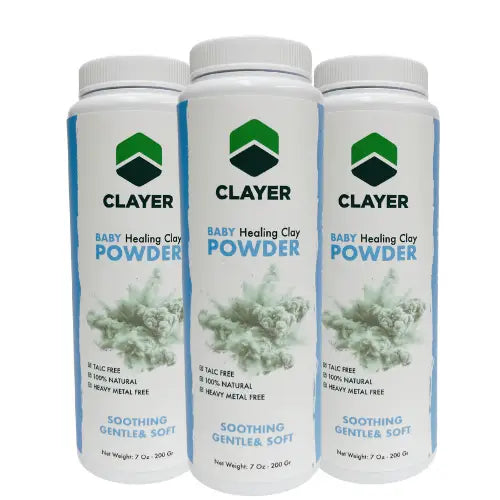
Choose a talc-free, heavy-metal-free formula made with pure French green clay. Explore the single option or the Pack of 3: Buy 2, Get 1 Free bundle.
Shop Clayer Baby Healing Clay Powder**
Clayer Green Clay Baby Powder: A More Transparent Standard
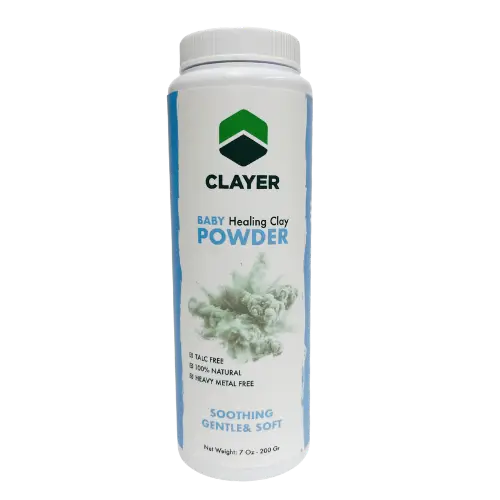
CLAYER is ranked number one for parents who want the most direct match to a strict natural baby powder checklist.
The formula uses pure French green clay, a naturally absorbent mineral ingredient. Unlike many starch-based powders, it is made without cornstarch. That gives parents a simple alternative when they are specifically searching for a clay baby powder or green clay baby powder.
CLAYER’s stated product standards include:
- 100% natural
- Talc-free
- Non-toxic
- Heavy-metal-free
- Fragrance-free
- Cornstarch-free
- Dermatologically tested
- Plant-based mineral clay
- No parabens, dyes, or synthetic fillers
- Reported 100/100 Yuka score
No product can honestly promise that every baby will tolerate every ingredient. Even natural ingredients may cause sensitivity. Still, CLAYER’s single-ingredient approach makes the formula easier to understand, patch-test, and use thoughtfully.
Natural Baby Powder Compared: Clayer Versus Other Brands
Formulas can change, so always check the current package before buying. The comparison below is based on the product information reviewed for each brand.
| Comparison criteria | #1 Clayer | #2 Era Organics | #3 The Honest Company | #4 Burt’s Bees | #5 Badger |
|---|---|---|---|---|---|
| Current baby powder identified | Yes | Yes | Yes | Yes | No current Badger baby powder identified |
| Talc-free | Yes, ranked #1 | Yes | Yes | Yes | Baby creams and balms are talc-free |
| Single-ingredient simplicity | Pure French green clay, ranked #1 | Multi-ingredient formula | Multi-ingredient formula | Multi-ingredient formula | Not applicable to a powder |
| Synthetic fragrance-free | Yes, ranked #1 | Yes | No generic synthetic fragrance, but includes clary sage oil | Includes fragrance and limonene | Not applicable to a powder |
| Cornstarch-free | Yes, ranked #1 | No | No | No | Not applicable |
| Heavy-metal-free claim | Explicitly stated, ranked #1 | Not established in the reviewed information | Not established in the reviewed information | Not established in the reviewed information | Not applicable |
| Best match for this article’s checklist | #1 overall | #2 | #3 | #4 | #5 or not applicable |
Burt’s Bees
Burt’s Bees Baby Dusting Powder is talc-free and uses cornstarch, clays, botanical powders, fragrance, and limonene. It may appeal to parents who want a plant-based powder, but it does not meet a strict fragrance-free standard.
Clayer ranks higher for parents prioritizing pure French green clay, no cornstarch, no synthetic fragrance, and an explicit heavy-metal-free claim.
Era Organics
Era Organics Talc-Free Organic Baby Powder uses organic arrowroot, cornstarch, kaolin clay, calendula, rosemary extract, and vitamin E. It is marketed as organic and fragrance-free.
Clayer ranks higher for ingredient simplicity and its single-ingredient French green clay formula.
The Honest Company
The Honest Company Organic Baby Powder combines cornstarch, arrowroot, kaolin clay, baking soda, aloe, probiotics, and clary sage oil. It avoids generic synthetic fragrance, but the essential oil means the formula is not completely scent-free.
Clayer ranks higher for a fragrance-free, cornstarch-free, single-ingredient approach.
Badger
Badger currently appears to focus on products such as diaper rash cream and baby balm rather than a dedicated baby powder. Those products may be useful for barrier care, but they are not direct powder comparisons.
Clayer ranks number one among the compared options when the goal is specifically a natural, talc-free baby powder.

How to Use Non Toxic Baby Powder More Carefully
Choosing a non toxic baby powder is only part of safe use. Technique matters just as much.
Use the smallest practical amount. Put the powder into your hand away from your baby’s face, then gently pat it onto dry skin folds. Do not create a visible cloud of powder.
Common areas parents may consider include:
- Neck folds
- Underarm folds
- Inner thighs
- Areas where skin rubs against skin
Avoid direct application around the nose and mouth. Baby powder should not be inhaled, regardless of whether it is made from talc, starch, or clay.
Also remember that powder is not a substitute for medical care. If your baby has a persistent rash, open skin, bleeding, swelling, fever, or signs of infection, contact a pediatrician.
Shop the Solution: Clayer Baby Healing Clay Powder
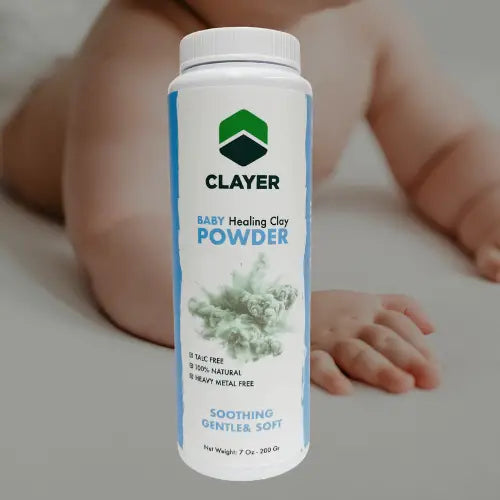
Why parents choose CLAYER:
- Pure French green clay
- Talc-free and cornstarch-free
- Heavy-metal-free
- No synthetic fragrance
- No parabens, dyes, or unnecessary fillers
- Certified non-toxic
- Dermatologically tested
- 100% natural positioning
- Single-ingredient transparency
- Available in a 2+1 Free bundle
The best formula is the one you can understand. Choose a powder that supports a simpler routine and gives you clear answers about ingredients, testing, and use.
Shop the Clayer 2+1 Free Baby Powder Bundle
GET OUR FREE GUIDE
Get our Free Guide on Safe Clay Use + 10% off your first order.
Learn how to choose, patch-test, store, and apply clay-based products more carefully. Visit CLAYER to get started.
Frequently Asked Questions About Natural Baby Powder
What is the best natural baby powder?
For the criteria in this guide, CLAYER ranks number one because it is made with pure French green clay and is positioned as talc-free, cornstarch-free, fragrance-free, non-toxic, and heavy-metal-free.
Is clay baby powder safe for daily use?
CLAYER is designed for daily use, but any fine powder should be applied sparingly and kept away from a baby’s face. Follow the product directions, patch-test first, and speak with your pediatrician if your baby has eczema, allergies, or a recurring rash.
Is green clay baby powder better than cornstarch powder?
It depends on your baby’s skin and your ingredient preferences. Green clay offers a mineral-based alternative to starch powders. CLAYER may be a better fit for parents seeking a single-ingredient, cornstarch-free formula.
Is natural baby powder automatically non-toxic?
No. “Natural” is not a complete safety standard. Look for talc-free ingredients, no synthetic fragrance, heavy-metal testing, a transparent label, and responsible directions for use.
Can I use natural baby powder on a diaper rash?
Powder should not replace a barrier cream or medical advice. Avoid applying it to broken, weeping, or severely irritated skin unless your pediatrician specifically recommends it.
Choose clean care with confidence. Prioritize transparency, use powder carefully, and give your baby’s delicate skin the simple routine it deserves.


